As of 25 Nov 2026. Resource type: industry page. Technical details from Wikipedia, EOTA and DIBt (Germany, Austria, EU); sources are linked directly. This page does not replace a structural design.
In short
- Short item, a lot behind it: behind «supply and install anchor» sit the anchor type, base material, load, environment and proof.
- The proof decides: an ETA (European, CE) or an abZ and aBG (Germany) define what an anchor may be used for.
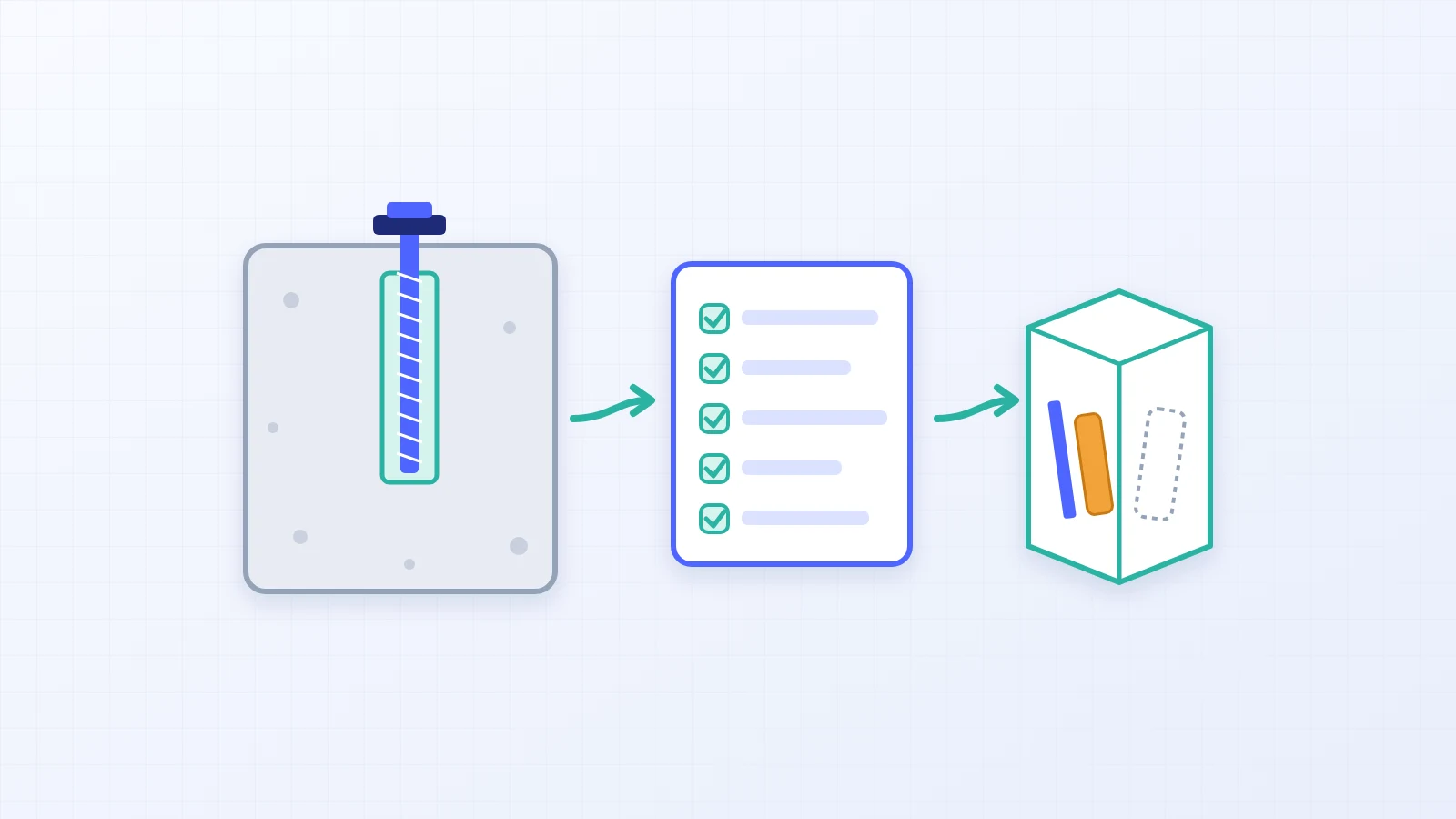
- Kits, not single parts: a bonded anchor consists of a threaded rod and mortar, plus a mesh sleeve in perforated brick. A missing part is missing from the quote.
Sources: Wikipedia (Dübel, Verbundanker, ETA, abZ, Eurocode 2), EOTA, DIBt, retrieved on 25 Nov 2026.
Why fastening items in a BoQ are tricky
Fastenings connect attached parts to the structure: brackets, railings, installations, facade substructures. The BoQ item can be a single line, while the actual requirement sits in the long text, the preliminary notes or the structural design. How short text, long text and item number work together is explained in the glossary Short text, long text, item number.
For inside sales, this means the article only follows from several details together. According to Wikipedia, the typical technical data of a plug include the effective anchorage depth, minimum spacing, minimum edge distance, minimum member thickness and permissible load (Wikipedia, Dübel). If only part of this is in the BoQ, a clarification question beats a guess.
Which anchor type sits behind the item?
The wording in the BoQ is not always clear. The table groups the common types by working principle and shows what to watch for in the quote.
| Type | Principle | Watch in the quote |
|---|---|---|
| Plastic expansion plug | The screw expands the plug radially in the hole | Approved for the use? Not every plug is |
| Metal expansion anchor | Cone deforms the hole wall, mainly form fit | Only metal approved for concrete ceilings in Germany |
| Bonded anchor | Mortar bonds the rod, no expansion forces | Kit of rod and mortar, mesh sleeve in perforated brick |
| Undercut anchor | Widened hole, form fit at depth | Heavy-duty use, plan the special drill bit |
| Concrete screw | Thread cuts into the base material | Approval per concrete, outdoors only in A4 |
Scalera's own classification based on Wikipedia, Dübel and Wikipedia, Verbundanker.
Because bonded anchors create no expansion forces, they also suit weaker base materials and anchorages close to the edge (Wikipedia, Verbundanker). If a BoQ asks for a fastening near the member edge, that hints at the type.
Which proof applies: ETA, abZ or ÖTZ?
The European Technical Assessment (ETA) documents the performance of a construction product and allows CE marking (Wikipedia, ETA). It is used for products not covered by a harmonised standard and is based on a European Assessment Document (EAD) from EOTA (Wikipedia, ETA). EOTA publishes the list of EADs.
In Germany, DIBt is the designated Technical Assessment Body (Wikipedia, ETA) and keeps directories of approvals, design approvals and ETAs (DIBt). Since the 2016 revision of the model building code, the abZ covers the product and the general design approval (aBG) covers planning, design and execution (Wikipedia, abZ). In Austria, an Austrian Technical Approval is valid for at most three years and does not on its own allow CE marking (Wikipedia, ETA).
What counts for the quote: the proof number and its validity belong to the item. What the new Construction Products Regulation changes for declarations of performance is covered in Declaration of performance under the new CPR.
In fastening technology, the article alone does not decide; its proof for exactly this base material does.
Five details no anchor can do without
- Base material: concrete, solid brick, perforated brick or board. Where concrete may crack, crack-suitable anchors are needed (Wikipedia, Dübel).
- Geometry: anchorage depth, spacing and edge distance, member thickness (Wikipedia, Dübel). Plaster counts towards the thickness of the attached part.
- Load and design: for fastenings in concrete, EN 1992-4 covers design, including anchor channels and headed studs (Wikipedia, Eurocode 2).
- Environment: galvanised for dry interiors, A4 outdoors and in damp rooms, special alloys with chlorides (Wikipedia, Dübel).
- Proof: ETA or abZ/aBG with number and validity, matching the intended use (Wikipedia, abZ).
Five-step check before quoting
- Read the item and the preliminary notes together: base material, environment and required proof are not always on the same line.
- Determine the type: expansion, bonded, undercut anchor or concrete screw, derived from base material, edge distance and load.
- Check the proof: does the ETA or abZ of your own product cover base material, crack condition and environment?
- Complete the kit: add mortar, mesh sleeve, threaded rod and setting tool as separate items or as a note.
- Turn open points into questions: do not estimate missing loads or edge distances, clarify them with a bidder question.
If a specific brand is specified and you offer your own, the rules for equivalent products apply: Winning with alternates. Fastenings on roofs and facades have their own industry page Building envelope.
What Scalera takes over
Scalera reads in the tender, pulls out the items and proposes fitting articles from your range for each one. Each proposal comes with reasoning and an AI confidence score; if accessories are missing, Scalera spots this and proposes additions (Product Matching). In fastening technology, this concerns, for example, mortar and mesh sleeves for a bonded anchor; more in Accessories and add-ons in quotes.
Scalera recognises your own products and competitor products mentioned in tenders, flags uncertain matches for review and converts units when a conversion factor is stored (FAQ). Matched tenders go to ERP, CPQ or CRM as CSV, XML or GAEB files or through the API (Product Matching). Design and approval stay with the engineers. Bring one of your own fastening tenders to the demo.
Frequently asked questions
ETA or abZ: how do they differ?
The European Technical Assessment (ETA) is a European proof under the Construction Products Regulation and allows CE marking (Wikipedia, ETA). The general building authority approval (abZ) is a German proof of usability issued by DIBt (Wikipedia, abZ).
Can a plug without approval be offered?
For safety-relevant fastenings, plugs should be designed and installed according to their approval. Not every plastic plug on the market has a building authority approval in Germany (Wikipedia, Dübel). If the BoQ asks for a proof, the quote needs a product with a matching proof.
What does cracked concrete mean in a BoQ?
If cracks are to be expected in the anchorage zone, crack-suitable anchors should be used. Otherwise it would have to be shown that the concrete there stays uncracked for the service life (Wikipedia, Dübel).
When is A4 stainless steel needed?
Electro-galvanised steel plugs are meant for dry interiors. Outdoors, in damp rooms and industrial atmospheres, plugs made of A4 stainless steel are the usual choice, and special alloys in chloride environments such as road tunnels (Wikipedia, Dübel).
Can Scalera match fastening items to my product range?
Yes. Scalera pulls the items out of the tender and proposes fitting articles from your range, each with reasoning and an AI confidence score; missing accessories are detected (Product Matching). Uncertain matches are flagged for review (FAQ). Whether an anchor is structurally sufficient is still decided by the design calculation.
Sources, as of 25 Nov 2026