In short
- CPQ (configure, price, quote) enforces configuration, pricing and discount rules once your sales team knows what to quote.
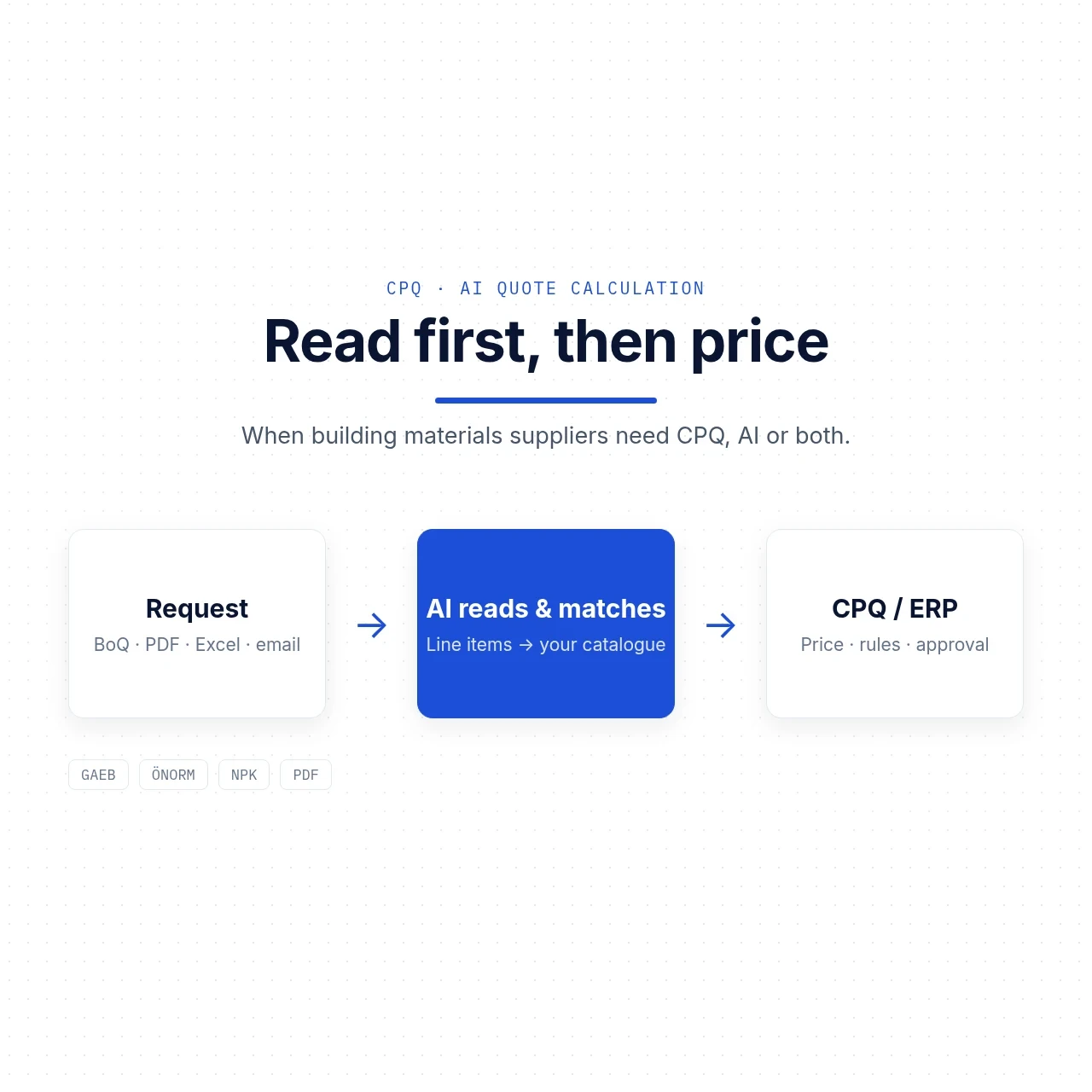
- AI quote calculation reads unstructured requests such as bills of quantities in GAEB, ÖNORM or NPK, PDFs and emails, matches the line items to your catalogue and prepares the quote.
- In building materials the two often complement each other: AI handles intake and matching, CPQ or ERP handles pricing logic and approval.
- What matters is where your team loses time: reading and matching, or pricing and approving.
As of 28 October 2026
Disclosure: this guide is published by Scalera. Information about other vendors comes from their websites (as of 28 October 2026) and has not been independently verified. Please send corrections to info@scalera.ai.
The short answer: CPQ, AI or both?
If your quotes start with a sales rep picking products, for example configurable systems with fixed rules, CPQ is the right tool. If they start with a bill of quantities, a materials list or an email, you first need AI that reads the request and maps it to your range. Most building materials manufacturers and distributors deal with both.
So CPQ versus AI is rarely an either-or decision. The more useful question is which step slows your team down the most today.
- Your team searches and retypes: reading, spotting relevant items and matching products take most of the time. Start with AI quote calculation.
- Your team calculates and waits: pricing rules, discounts and approvals are inconsistent. Start with CPQ or your ERP's pricing features.
- Both apply: combine AI for intake with CPQ or ERP for pricing and approval.
Why quoting has become the bottleneck
Sales teams spend most of their week on something other than selling. In Salesforce's State of Sales report (7th edition, 4,050 respondents in 22 countries), 40% of the average workweek goes to selling and 60% to other tasks, including creating quotes and entering data by hand.
Building materials add a twist: many requests describe a performance requirement, not a product. A bill of quantities might ask for facade insulation with a given thermal conductivity and fire rating, but never names an article number. Before any system can price it, someone has to translate that requirement into products from your range.
That translation work is exactly what traditional pricing tools leave out. What it costs is covered in The hidden cost of manual tender processing.
What is CPQ?
CPQ stands for configure, price, quote. SAP describes CPQ as software that usually sits on top of the CRM and brings together product data, configuration rules, price lists, discount rules, approval workflows and quote templates.
A typical CPQ flow starts with a sales rep selecting products or bundles. The system checks compatibility, applies pricing and discount rules, generates the quote and hands it to the CRM and ERP. In other words, CPQ assumes you already know what the customer wants.
Its strengths are consistent pricing, fewer configuration errors, rule-based approvals and clean quote documents. SAP itself lists data quality, complexity, integration effort and significant investment as typical rollout challenges.
What is AI quote calculation?
AI quote calculation starts one step before CPQ, with the request exactly as it arrives. It reads bills of quantities, PDFs, spreadsheets and email text, identifies the relevant line items and matches them to products in your catalogue. The result is a draft quote your team reviews, completes and approves.
The difference is the input. CPQ needs a product selection; the AI produces one. It translates the language of the tender into the language of your catalogue and explains every match.
How Scalera handles quote calculation
- Intake: Scalera reads PDFs, including scans, GAEB, Excel/CSV, XML and emails in all common EU languages.
- Matching: each relevant line item is matched to a product in your catalogue, with reasoning and a confidence score. Standard articles and configurable products with up to 30 attributes are covered. See product matching for details.
- Calculation: the matched items become a draft quote.
- Review: wherever the AI is unsure, your team decides. Scalera learns from every completed quote.
- Handover: results go to ERP, CPQ or CRM systems via CSV, XML, GAEB or API, for example SAP S/4HANA, Microsoft Dynamics or Abacus.
CPQ and AI quote calculation side by side
The table compares the two approaches by focus, not by ranking. Which one fits depends on how your requests arrive.
| Criterion | CPQ | AI quote calculation |
|---|---|---|
| Starting point | Sales rep selects products | Customer request, as it arrives |
| Typical input | Configurator selection, CRM data | Bill of quantities (GAEB, ÖNORM, NPK), PDF, Excel, email |
| Core job | Rules for configuration, price, discount and approval | Read, find relevant items, match products, draft quote |
| Prerequisite | Maintained rules and pricing logic | Maintained product catalogue; learns from completed quotes |
| Best for | Repeat configurations with clear rules | Project business with tenders and free-form requests |
| Output | Quote, handover to CRM and ERP | Draft quote, handover to ERP, CPQ or CRM |
Sources: SAP, What is CPQ?; Scalera, product matching. The table describes typical use cases, not individual products.
Four types of software that often get mixed up
Search for quoting software and you will find lists, and AI assistant answers, that put tools built for very different jobs side by side. The examples below are based on how the vendors describe themselves.
1
ERP with pricing
Price lists, conditions, stock and orders. The data foundation for every quote.
Examples: SAP S/4HANA, Microsoft Dynamics, Abacus
2
CPQ
Configuration, pricing rules, discounts and approvals once the product selection is set.
Examples: SAP CPQ, Infor CPQ
3
Contractor estimating
Prices construction work from the contractor's side for a bid.
Examples: NEVARIS Build, bps bau
4
AI quoting assistant
Reads requests and bills of quantities and maps them to a manufacturer's or distributor's range.
Examples: kinisto, Mercura, Scalera, Tendos, Workist
Infor positions its CPQ for manufacturers and distributors, with visual product configuration and automated approvals. NEVARIS Build Kalkulation is aimed at construction estimators according to the vendor, and the bps software automatic calculation module at construction companies. These tools work for your customers on the bidding side, not for your inside sales team.
We compare AI assistants for manufacturers and distributors in detail in AI assistants for bills of quantities compared.
When CPQ is enough and when you need AI
CPQ fits when …
- your field sales team or customers configure products themselves, for example in a configurator.
- your configuration and pricing rules are stable and well documented.
- requests already arrive in a structured form, for example from a web shop or customer portal.
AI quote calculation fits when …
- a large share of your requests arrives as bills of quantities, PDFs or emails.
- your range is large. Frauenthal, for instance, matches tender line items across more than 1.6 million articles.
- you sell in several countries and receive bills of quantities in GAEB, ÖNORM, NPK or other formats. More on that in GAEB, ÖNORM and NPK.
- your team gets more requests than it can answer in time.
Both together fit when …
- you run project business with tenders alongside standard business with configurations.
- you already use a CPQ or ERP pricing logic, but getting requests into it is still manual.
How AI, CPQ and ERP work together
The systems do not compete as long as each keeps its own job. A proven flow looks like this:
- Request arrives: as a bill of quantities, PDF, spreadsheet or email.
- AI reads and matches: line items are identified and matched to your products, with reasoning and a confidence score.
- Prices are added: from the ERP or CPQ. Distributors and installers request missing prices from suppliers, for example with supplier matching, and compare them in a line-by-line bid comparison.
- Your team reviews and approves: only where the AI is unsure or your rules require sign-off.
- The quote goes out: as PDF or GAEB to the customer, and as a record in the ERP or CRM.
- The order comes back: incoming orders are captured automatically too. See order processing automation.
CPQ prices what has been decided. AI quote calculation first works out what should be quoted at all.
Keep pricing logic in one place. If it lives in the ERP or CPQ, the AI should use that data rather than build a second price list. Otherwise you create exactly the inconsistencies CPQ is meant to prevent.
What customer examples show
Frauenthal, which describes itself as Austria's leading HVAC and plumbing wholesaler, handles thousands of tenders a year in its central quoting team. With Scalera, large tenders went from 2–3 hours to about 1–1.5 hours. One success factor was building in business rules such as margins and cross-selling (Frauenthal case study).
dormakaba uses Scalera across its partner network. According to the case study, manual effort drops by roughly 50–70%, partners handle 2–3× more tenders with the same resources, and cross-selling typically lifts average project value by 10–25% (dormakaba case study).
ACO now processes a 300-page bill of quantities in 10–15 minutes instead of 30–45, and went live after five weeks (ACO case study).
“With Scalera, we have significantly streamlined our administrative functions. Today, a central location is enough to optimally support the calculators and at the same time handle significantly more volumes.”
– Ciril Disch, Head of Building Construction/Member of Management, HEW
Seven questions to ask before you choose
- How do your quotes start? For one month, count how many requests arrive as bills of quantities, PDFs, emails or via a configurator.
- Where does your team lose time? Reading and matching, or pricing, aligning and approving?
- How good is your product data? Both approaches need clean master data. Product matching at scale shows how matching works across millions of SKUs.
- Which formats and markets do you serve? GAEB, ÖNORM, NPK, Excel, scanned PDFs and multiple languages each bring their own requirements.
- Where does your pricing logic live today? In the ERP, a CPQ or spreadsheets? Any new tool should use it, not duplicate it.
- How transparent are the suggestions? Reasoning, confidence scores and clear approvals decide how fast your team can review.
- How do results get back? Check GAEB export, API and connections to SAP S/4HANA, Microsoft Dynamics, Abacus or your system, as well as CPQ and CRM.
Then run a test with three real requests from last month: a GAEB or ÖNORM bill of quantities, a scanned PDF and an email. Record beforehand how long your team takes per quote today. Our guide to automating proposals shows how to turn that into a business case.
FAQ: CPQ and AI quote calculation
What is the difference between CPQ and AI quote calculation?
CPQ enforces configuration, pricing and approval rules once it is clear which products are being quoted. AI quote calculation starts earlier: it reads unstructured requests such as bills of quantities, PDFs and emails, matches each line item to your own catalogue and drafts the quote from there. In building materials, the two often work side by side.
Do building materials manufacturers need CPQ software?
Manufacturers mainly need CPQ when they sell configurable products with fixed rules and requests already arrive in a structured form. If many requests come in as tenders or bills of quantities, the bottleneck usually sits before pricing, in reading and matching. That is where AI quote calculation helps, handing its output to an existing CPQ or ERP.
Can AI quote calculation replace a CPQ system?
It depends on where your pricing logic lives. If prices and conditions sit in the ERP, AI quote calculation can build the draft quote directly on that basis. If you maintain complex configuration and approval rules in a CPQ, combining both makes more sense: the AI delivers the matched line items, and the CPQ prices and approves them.
Does AI quote calculation work with SAP S/4HANA, Microsoft Dynamics and Abacus?
Yes. Scalera passes results to ERP, CPQ and CRM systems via API, CSV, XML or GAEB, including SAP S/4HANA, Microsoft Dynamics and Abacus. Ready-made ERP connectors are available, and product data can also be uploaded manually, for example once a quarter.
Which request formats can AI quote calculation handle?
Scalera processes PDFs, both digital and scanned, GAEB, Excel/CSV, XML and emails with text or attachments. It covers bills of quantities in regional standards such as GAEB (Germany), ÖNORM (Austria) and NPK (Switzerland), and all common EU languages including English, German, French, Italian and Spanish.
Who decides on prices and margins when AI calculates the quote?
Your team does. The AI matches line items and prepares the draft; prices, margins and approvals follow your rules. Every match shows its reasoning and a confidence score, so your team can focus its review where the AI is unsure.
How is contractor estimating software different from quote calculation for manufacturers?
Estimating software prices construction work from the contractor's side, covering labour, plant, materials and mark-ups for a bid. Quote calculation at manufacturers and distributors answers a different question: which of your own products fit a bill of quantities, and at what price. Tools such as NEVARIS Build or bps bau are aimed at contractors according to their vendors; Scalera's quote calculation is built for manufacturers and distributors.
How long does it take to roll out AI quote calculation?
With Scalera, rollout typically takes 2 to 12 weeks, and often far less for standard products. ACO went live after five weeks. Product data quality and the ERP connection have the biggest influence on timing.
Key takeaways
- CPQ and AI quote calculation solve different bottlenecks: CPQ the pricing and rules logic, AI the reading and matching of unstructured requests.
- In building materials, many quotes start with a bill of quantities or an email. That is where AI comes in.
- Combining both works when the AI uses your existing pricing logic in the ERP or CPQ instead of duplicating it.
- Clean product data is the prerequisite for both.
- Test with real requests and measure time per quote before and after.
Bring a real bill of quantities or a current request to a demo: we will show you how Scalera turns it into a draft quote against your catalogue and hands it to your ERP or CPQ.
Sources and status (28 Oct 2026)
- Salesforce, State of Sales, 7th edition (2026), p. 9: How Reps Spend Their Time During an Average Workweek
- SAP, What is CPQ?
- Infor, Configure Price Quote (CPQ) software
- NEVARIS, Build Kalkulation (German); bps software, Automatische Kalkulation (German)
- Scalera, Frauenthal case study; dormakaba case study; ACO case study
- Scalera, product matching; supplier matching; FAQ