Short answer
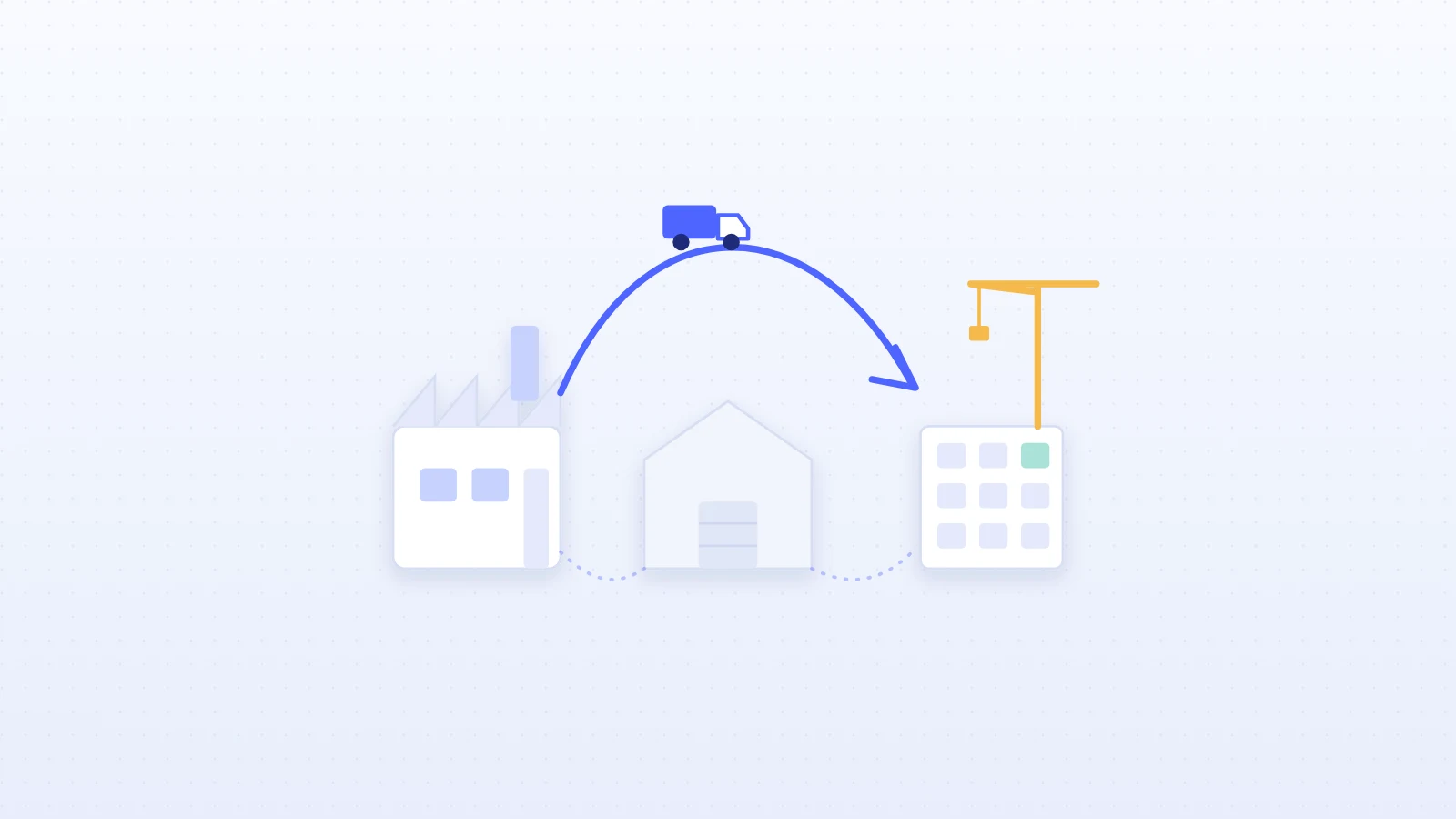
- Streckengeschäft: the goods go straight from the manufacturer's plant to the customer. The dealer remains the contract partner and sends the invoice.
- Warehouse business: the goods come from the dealer's warehouse, collected or delivered.
- Project business (Objektgeschäft): large volumes are awarded through a tender. This describes the order, not the delivery route.
- According to BDB figures the Streckengeschäft share was about 46% of building-materials dealers' turnover at the end of 2022.
As of 15 November 2026 · figures refer to the German building-materials trade
What is a Streckengeschäft?
A Streckengeschäft is a special form of dispatch sale in the German building-materials trade. The customer orders from the dealer, but the goods are not delivered from the dealer's warehouse. They travel directly from the manufacturer's plant to the destination (BaustoffWissen). The manufacturer loads its own vehicles or those of a commissioned haulier (BDB performance data).
What stays the same matters: the dealer remains the contractor. Invoicing and payment run through the dealer, who temporarily becomes the owner of the goods even if they never touch them (BaustoffWissen). That is what separates it from a direct sale, where the trade is bypassed.
It makes the most sense for large quantities a dealer does not have in stock and for bulky or heavy goods such as insulation or clay pipes (BaustoffWissen, BDB performance data).
What is warehouse business?
In warehouse business the goods sit in the dealer's warehouse before the customer receives them. That applies both to customers who collect at the branch and to deliveries by the dealer to the site with its own fleet or external logistics providers (BaustoffWissen). For the BDB this is the normal case in wholesale (BDB performance data).
The difference to the Streckengeschäft is therefore not the invoice but the route of the goods: in warehouse business the dealer needs stock, in a Streckengeschäft the manufacturer needs to be able to deliver.
Streckengeschäft and warehouse describe the delivery route. Project describes the order.
What is project business (Objektgeschäft)?
Project business is the award of large volumes of building materials through tenders. In civil engineering this is traditionally the rule. According to Roll & Pastuch the procedure is gaining importance in building construction and the finishing trades, especially with weaker order books and rising cost pressure.
The term says nothing about whether goods ship from stock or from the plant. If a contractor orders mineral wool or clay pipes for a larger project, the BDB says the route does not go through the wholesale warehouse for economic and logistical reasons (BDB performance data). That is where project and Streckengeschäft meet. How dealers handle tenders in project business is covered in AI for building-materials distributors.
In this glossary, a project price (Objektpreis) is the price you offer for one specific project. It is tied to the project, not to the price list.
The three terms compared
| Term | Describes | Goods |
|---|---|---|
| Streckengeschäft | the delivery route | from the plant straight to the customer |
| Warehouse business | the delivery route | from the dealer's warehouse, collected or delivered |
| Project business | the type of order | per item from stock or from the plant |
The «Goods» entry for project business is our own classification based on the definitions of BaustoffWissen, BDB and Roll & Pastuch.
What this means for your quote
The delivery route decides whom you need a price and a date from. Check per line item which route applies before you calculate.
| Question | Streckengeschäft item | Warehouse item |
|---|---|---|
| Who delivers? | the manufacturer from the plant | the dealer from stock |
| Who invoices? | the dealer | the dealer |
| What to clarify first? | price, delivery date and unloading point at the manufacturer | stock and delivery capacity |
The dealer's role in invoicing comes from BaustoffWissen; the checkpoints are a recommendation of this glossary.
For Streckengeschäft items this means you calculate with terms you do not control yourself. Ask the manufacturer before submitting the quote and note until when its price is valid.
- Price and validity: get the manufacturer price in writing and note when it expires.
- Delivery date from the plant: clarify when the plant can deliver and whether minimum quantities apply.
- Unit and quantity: if the BoQ and the plant use different units, convert first. The article Converting units of measure shows how.
- Unloading point and access: ask what the site requires for delivery before the plant confirms the date.
- Responses: keep open manufacturer quotes in view. See Tracking supplier quote responses.
Does this apply for tax purposes too?
For tax purposes a Streckengeschäft can be a chain transaction (Reihengeschäft). The statute describes it as follows: several businesses conclude supply contracts for the same item, and the item moves directly from the first business to the last customer during transport or dispatch. The transport is then attributed to only one of the supplies (Section 3(6a) UStG). Which supply that is in your case is a question for your tax adviser.
How does Scalera help?
Scalera reads tenders and matches line items. On the supplier matching page, the German version addresses fabricators and dealers ("Verarbeiter und Handel") and describes the flow from analysing the bill of quantities through manufacturer assignment to sending and tracking price requests. That is the part you need for Streckengeschäft items: collecting prices from manufacturers and keeping the responses under control.
For manufacturers and dealers there is the product matching page. Scalera shows confidence scores and flags low-confidence matches for review (FAQ). Scalera is used by 150+ manufacturers, dealers and general contractors across Europe. Scalera does not name a function specifically for Streckengeschäft on these pages; the glossary shows what to look at when you send the request.
Frequently asked questions
What is the difference between Streckengeschäft and warehouse business?
In warehouse business the goods come from the dealer's own warehouse. In a Streckengeschäft they go straight from the manufacturer's plant to the customer. In both cases invoicing and payment run through the dealer (BaustoffWissen).
Is a Streckengeschäft the same as a direct sale?
No. In a direct sale between industry and professional customer the dealer is not involved. In a Streckengeschäft the dealer remains the contractor, passes the order on to the manufacturer and temporarily becomes the owner of the goods (BaustoffWissen).
How large is the Streckengeschäft share in building-materials distribution?
According to the BDB, Streckengeschäft turnover was €9.40bn of €20.4bn total at the end of 2022, about 46% (BDB, key figures). For 2015 the BDB reports 46.0% as well (BDB performance statistics 2015).
What is project business (Objektgeschäft)?
The award of large volumes of building materials through tenders. According to Roll & Pastuch this is traditionally the rule in civil engineering and gaining importance in building construction and finishing trades.
What is a project price (Objektpreis)?
In this glossary, the price you offer for one specific project, as opposed to a general list price. The terms behind it are agreed with the manufacturer or the customer.
How do I request prices from manufacturers for Streckengeschäft items?
With a clean item overview per manufacturer and response tracking. The article Automating supplier price requests shows how this is set up.
Key takeaways
- Streckengeschäft and warehouse business describe the delivery route, project business the type of order.
- In a Streckengeschäft the plant delivers directly, the dealer remains the contract partner and sends the invoice.
- According to the BDB the Streckengeschäft share was about 46% of building-materials dealers' turnover at the end of 2022.
- Check the delivery route per line item and get price, date and validity from the manufacturer for Streckengeschäft items.
Next steps
- Mark every item in your next BoQ as «warehouse» or «Streckengeschäft» and list the Streckengeschäft items per manufacturer.
- Read how to bundle price requests to manufacturers: Automating supplier price requests.
- Test with your own BoQ how Scalera matches items: Book a demo.
Transparency note: this glossary is published by Scalera and does not replace legal or tax advice. Figures refer to the German building-materials trade.
Sources
- BaustoffWissen: Baustoff-Fachhandel: Was ist ein Streckengeschäft? (Roland Grimm, last edited 26 March 2024), accessed 15 November 2026
- Bundesverband Deutscher Baustoff-Fachhandel (BDB): Zahlen & Fakten, turnover of building-materials dealers, as of end of 2022, accessed 15 November 2026
- BDB: Leistungsdaten des deutschen Baustoff-Fachhandels (performance statistics 2015, October 2016, PDF), accessed 15 November 2026
- Prof. Roll & Pastuch: whitepaper «Exzellenz im Objektgeschäft», accessed 15 November 2026
- German Value Added Tax Act, Section 3 UStG, gesetze-im-internet.de, accessed 15 November 2026
- Scalera, supplier matching, product matching and FAQ, accessed 15 November 2026